Treatment Comparison · Atlanta, GA

Surgery isn't always the next step

For patellar tendinopathy specifically, a range of non-surgical and minimally invasive options exist before open surgery becomes necessary. Here's how the two paths actually compare.

Surgery
general anesthesia
TenJet
local anesthesia
15 min
in-office procedure

In Their Words

Beyond the Clinical Description

A patellar tendinitis patient explains what chronic knee pain cost them day to day, and what changed after the tenotomy.

TenJet Patient Testimonial - Chronic Patellar Tendinitis (Jumper's Knee)

Video courtesy of HydroCision, Inc., the maker of TenJet®. Individual results vary; this patient's experience is not a guarantee of outcome. Talk with a specialist about whether the procedure is appropriate for you.

Comparing Your Options

Open Surgery vs. Non-Surgical / Minimally Invasive

Neither path is universally right — the correct choice depends on how long you've had symptoms, how severe the tendon degeneration is, and what's already been tried.

Open Surgery

  • General anesthesia required
  • Longer recovery, often months
  • Reserved for severe, unresponsive cases
  • Higher upfront risk profile

Non-Surgical / Minimally Invasive

  • Local anesthesia, in-office setting
  • Faster return to activity
  • Appropriate for most tendinopathy cases
  • Lower risk, often tried first

The Procedure

One option in the middle ground: TenJet®

If you're weighing surgery against doing nothing, it helps to know there's a documented step in between. TenJet, made by HydroCision, Inc., removes degenerated tendon tissue in an office visit rather than an operating room.

Performed with local anesthesia, not general
Ultrasound guidance keeps the approach precise
A saline stream and built-in suction clear damaged tissue in one pass
Healthy tendon fibers are deliberately preserved
Most insurance plans, including Medicare, reimburse it
Compare it directly on HydroCision's site →

See The Procedure

TenJet® in Action

Official demonstration video from HydroCision, the maker of TenJet, plus a look at how tendinitis differs from the deeper tissue degeneration TenJet is designed to treat.

TenJet Patella Tendinosis Minimally Invasive Tenotomy

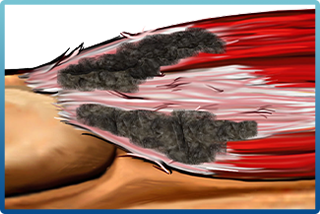
Healthy tendon fiber structure diagram
Healthy Tendon
Tendinitis inflamed tendon diagram
Tendinitis
Tendinosis degenerated tendon fiber diagram
Tendinosis (Chronic Degeneration)

Diagrams and video courtesy of HydroCision, Inc.

Common Questions

Frequently Asked Questions

How long do people usually have symptoms before treatment?

Often years. One published patient had experienced intermittent anterior knee pain for four years, worsening in the six months before he sought further treatment.

Does it interfere with everyday life or just sport?

Both. The same documented patient described difficulty playing with his children and carrying objects upstairs, not merely limitations during athletic activity.

What pain levels are typical beforehand?

Published cases describe daily pain around 3 to 4 out of 10, rising to 7 out of 10 with activity, before intervention.

How quickly do pain scores change?

In that case pain was 2 to 3 out of 10 at two weeks and 1 to 2 out of 10 at eight weeks. Individual trajectories differ.

This information is general and is not medical advice. Whether any procedure is appropriate for you can only be determined by a physician who has examined you and reviewed your imaging.

Speak Directly With Each Physician's Office
Call the office below that matches the specialist you'd like to see.
CC
Sports Medicine & PM&R
Northside Hospital Orthopedic Institute
(770) 795-5620
MS
Non-Operative Orthopedics
Northside Hospital Orthopedic Institute
(770) 758-5059
KK
Dr. Kamal Kabakibou, MD
Interventional Pain Medicine
Center for Pain Management, Atlanta
(404) 882-9778
EO
Interventional Pain Medicine
OlympusMD Pain & Wellness
(770) 629-9023
OH
Interventional Pain Medicine
OlympusMD Pain & Wellness
(770) 629-9023
UN
PM&R & Spine
Resurgens Orthopaedics, Covington & Decatur
(404) 856-3706